Enterprise Design Patterns
by: Gilmer Donaldo Mamani Condori
Introduction
In the world of software engineering, applications don’t just live in isolation—they interact with databases, integrate with external services, and evolve alongside business rules. As complexity grows, so does the need for reusable solutions that address recurring problems. This is where Enterprise Design Patterns, as cataloged in Patterns of Enterprise Application Architecture by Martin Fowler, become indispensable.
These patterns help architects and developers manage complexity, ensure maintainability, and promote scalability across enterprise-grade applications.
In this article, we will break down what Enterprise Design Patterns are, explore a key example from Fowler’s catalog, and implement a real-world code example in Python.
What Are Enterprise Design Patterns?
Enterprise Design Patterns are recurring solutions to common challenges faced in large-scale, business-critical applications. They are not tied to any single technology stack, but instead provide general approaches that can be adapted in languages like Java, Python, Ruby, or even JavaScript.
Some of the most recognized categories include:
Domain Logic Patterns – Structuring business logic (e.g., Transaction Script, Domain Model, Table Module).
Data Source Architectural Patterns – Managing persistence (e.g., Data Mapper, Repository, Active Record).
Object-Relational Behavioral Patterns – Handling mismatches between objects and relational databases (e.g., Lazy Load, Identity Map, Unit of Work).
Web Presentation Patterns – Structuring user interaction logic (e.g., MVC, Front Controller, Template View).
Each of these patterns helps developers to decouple concerns and provide consistency across enterprise systems.
Definition
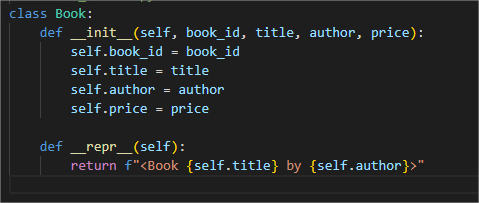
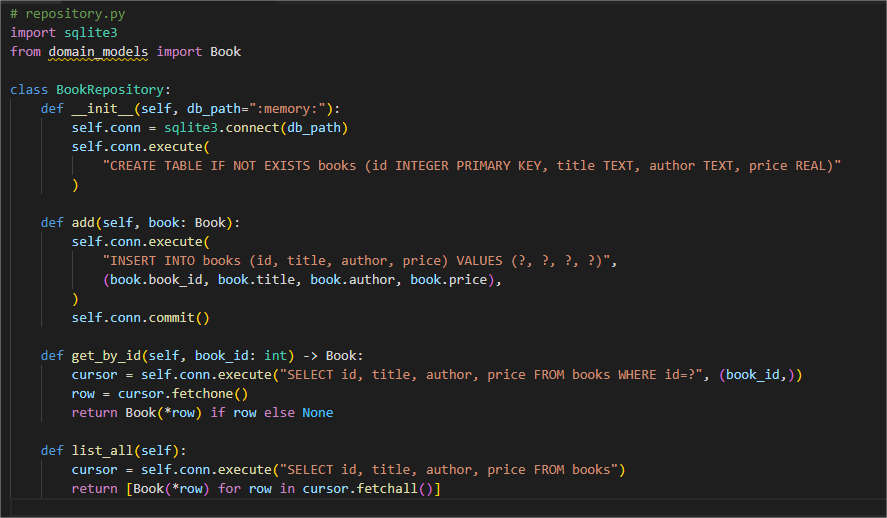
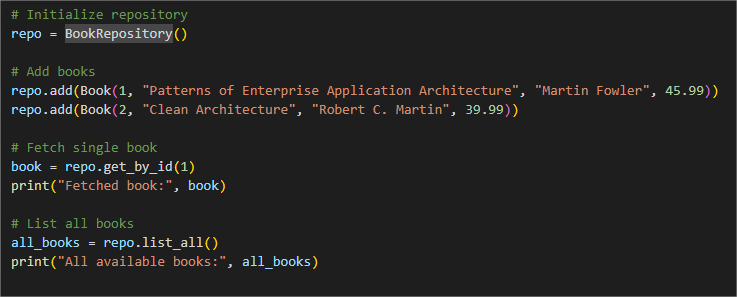
The Repository Pattern acts as a mediator between the domain and data mapping layers, providing a collection-like interface for accessing domain objects.
Instead of scattering database queries throughout your code, you centralize them in a repository. This leads to cleaner separation of concerns:
Domain Layer: Focuses on business rules.
Repository Layer: Deals with data persistence and retrieval.
Example in Python
Why This Matters
In real enterprise environments, databases, APIs, and even microservices come and go. By abstracting persistence behind repositories (or other enterprise patterns like Data Mapper, Unit of Work, or Service Layer), systems remain flexible and less brittle in the face of change.
For instance:
Migrating from SQLite to PostgreSQL only requires changing the repository implementation.
Business rules in the domain model remain untouched.
Code becomes easier to test, since repositories can be mocked.
Other Enterprise Patterns
Other critical patterns include:
Domain Model – Encapsulates business logic within rich objects.
Unit of Work – Tracks changes and ensures atomic commits to the database.
Identity Map – Keeps track of loaded objects to avoid duplicates.
Front Controller – A centralized entry point for handling web requests.
Conclusion
Enterprise Design Patterns remain highly relevant in modern architectures, from monolithic systems to microservices. They are not just academic concepts but practical tools that can dramatically reduce complexity in real-world systems.
By adopting patterns like Repository, developers can create scalable, maintainable, and testable applications that stand the test of time.